VIP Partner App

VIP Tools & Forms
Your centralized hub for carrier tools, quoting and implementation steps, marketing assets, and partnership management. Access everything you need to grow your voluntary benefits business in one place.
VIP Sales and Pipeline Training Portal
Introduction: Why Master the Art of Closing?
Closing is the final step in the pursuit of any goal. It isn't just something sales people do; it applies to every person. Nothing truly happens until you are able to engender the support, energy, and resources of others.
The ability to close is what separates those who have from those who don't. It differentiates the dreamer from the person who realizes those dreams. Think of the most influential people in history—from inventors to world leaders—they were all great closers. They were able to instill support from others so they could get their ideas backed with money, energy, and effort.
The purpose of this guide is to dig deep into why people do and don't close deals. We will explore the underlying reasons you might not be closing as many deals as you could and provide the "how" to fix it.
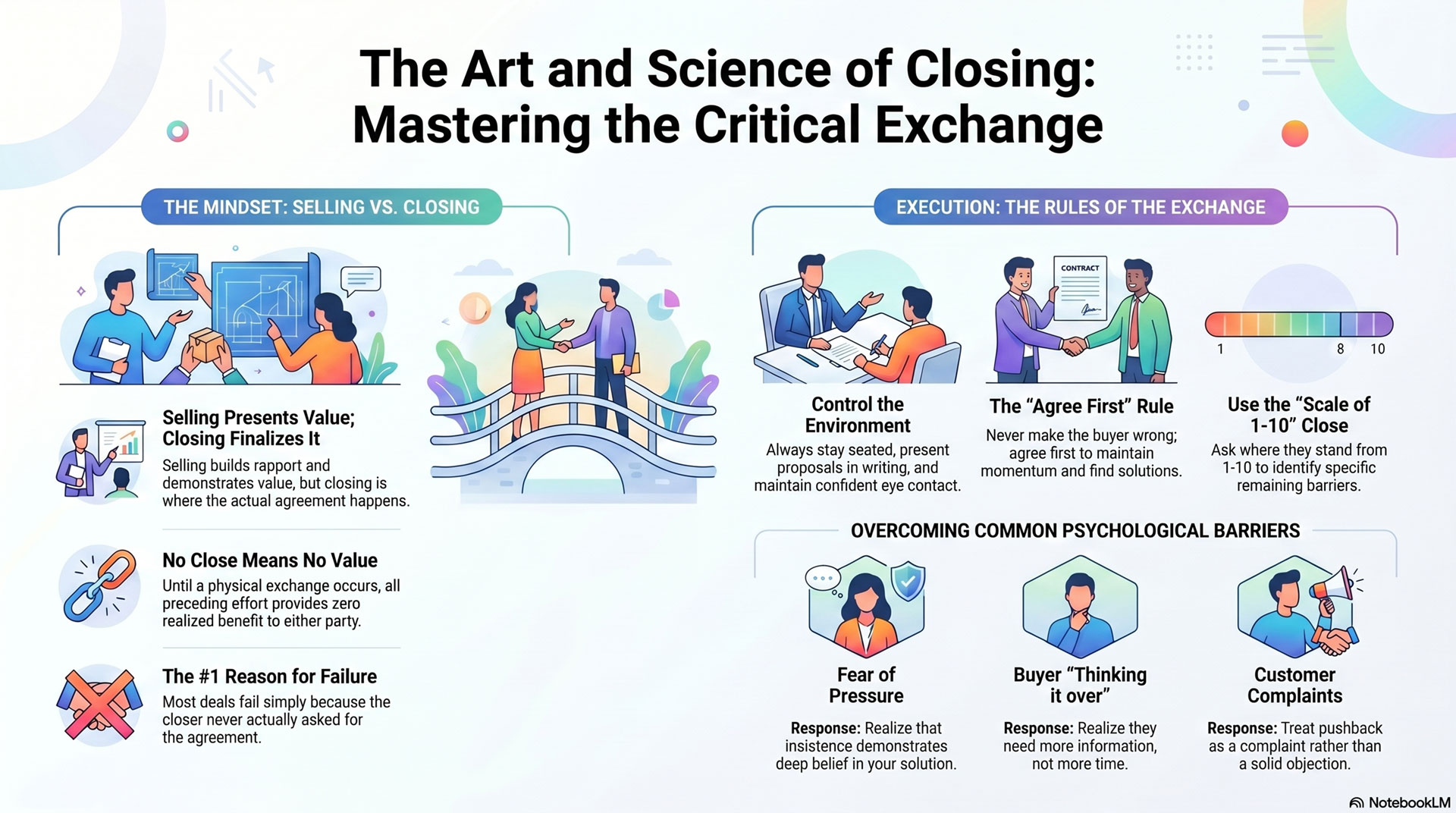
Selling vs. Closing: The Critical Distinction
Have you ever met someone great at demonstrating a product or building rapport but terrible at finalizing the deal? To get good at both, you must treat them as separate tasks.
- No Close Means No Commission: If you don't close, you don't get paid. Selling is where the value proposition is made; closing is where the agreement is finalized.
- No Close Means No Exchange: Until you close, you cannot offer any real value. The close is the moment where a physical exchange is made between two parties.
The closing step determines your income. It is often the most feared and misunderstood part of the process, but with the right mentality, you will no longer fear it.
The Science of the Exchange
The close is the critical exchange point where you quit selling and pitching and get your prospect to take action. If there is no exchange and no action, there is no close.
Mastering the Critical Exchange Point
Think of it like exercise. Do you benefit from a workout if there is no physical change? Until you see results, the actual working out is just effort without the realized benefit. Similarly, you only create real value for your client when you get an exchange. Until the agreement and exchange take place, everything that preceded it has limited value.
10 Reasons People Fail to Close
- Never Attempted to Close: This is the biggest reason. If you don't ask for the agreement, you won't get it.
- Pressure Perceived as Bad: Social training often teaches us that insistence is rude. However, pushing through resistance demonstrates you are sold on your solution.
- Unwillingness to Deal with Emotions: Negotiations involving money and decisions can get emotional. Remain calm and logical while your client processes these feelings.
- Lack of Belief: You must believe in your service at a deep level to control the close.
- Incorrect Estimation of Effort: People often underestimate how much energy it takes to get a "yes." Always be prepared for a difficult situation.
- Being 'Reasonable': Urgency is often missing in daily habits. Approach every task with a sense of completion.
- No Financial Plan: If you are just working to pay bills, you won't have the motivation to do the uncomfortable things needed to close.
- Treating Complaints as Objections: Most pushback is just a complaint. Treat it as such until it is validated as a real barrier.
- Shortage of Material: A great closer has a deep arsenal of practiced and rehearsed closes.
- Incorrect Barriers: Many believe the customer is the barrier. In reality, your own beliefs and agreements with objections are what stop you.
20 Basic Rules to Close the Sale
- Always be seated: Sell on your feet, close from your seat.
- Always present in writing: Never talk about a proposal without a written document.
- Clearly communicate: Don't mumble; clearly ask for the order.
- Make eye contact: Be confident and determined.
- Have your tools ready: Always have a pen or contract available.
- Use humor: Relieve pressure with a well-timed line.
- Ask one more time: Most people don't ask enough.
- Have an arsenal: Be prepared for every possible stall.
- Stay with the buyer: Keep the momentum going.
- Treat them like a buyer: Regardless of what they say, treat them as someone who can decide.
- Know you can reach an agreement: Keep suggesting it.
- Maintain a positive demeanor: Don't mirror the buyer's negativity.
- Keep smiling: A smile can break tension better than words.
- Treat the client like they can: Reaffirm their ability to afford or decide.
- Acknowledge communication: Thank them for their input, then pivot back.
- Agree first: Never make the buyer wrong.
- Look for solutions: If you stop looking, the deal is over.
- Care enough to refuse not to close: Insistence is a form of caring.
- Use your full arsenal: Don't rely on just one or two techniques.
- See closing as a service: You get paid, and they get the solution they need.
The Closer's Arsenal: Strategic Responses
The 'Either Way' Close: "Either way, you make a decision today. You can continue with what you have or choose what you deserve. All decisions have a cost—doing nothing costs you just as much as something new."
The 'Wait' Close: "Certainly you can wait, but let's look at what happens. The need doesn't go away, costs may go up, and nothing improves. Let's handle this now so you can focus on other things."
The 'Thinking About It' Close: "Thought is instantaneous. What you likely need is more information, not more time. What is the specific concern we haven't addressed yet?"
The 'Scale of 1-10' Close: "On a scale of 1 to 10, where are you on this decision? What would it take to make it a 10?"
The 'Right Thing' Close: "Regardless of the hesitancy, you know this is the right thing for your situation. Let's make it happen."
Slide Deck
Quick Resources
Audio Deep Dive
Take Quiz
Mastering Consistent, System-Driven Prospecting (Mixed-Experience Edition)
Course Objective
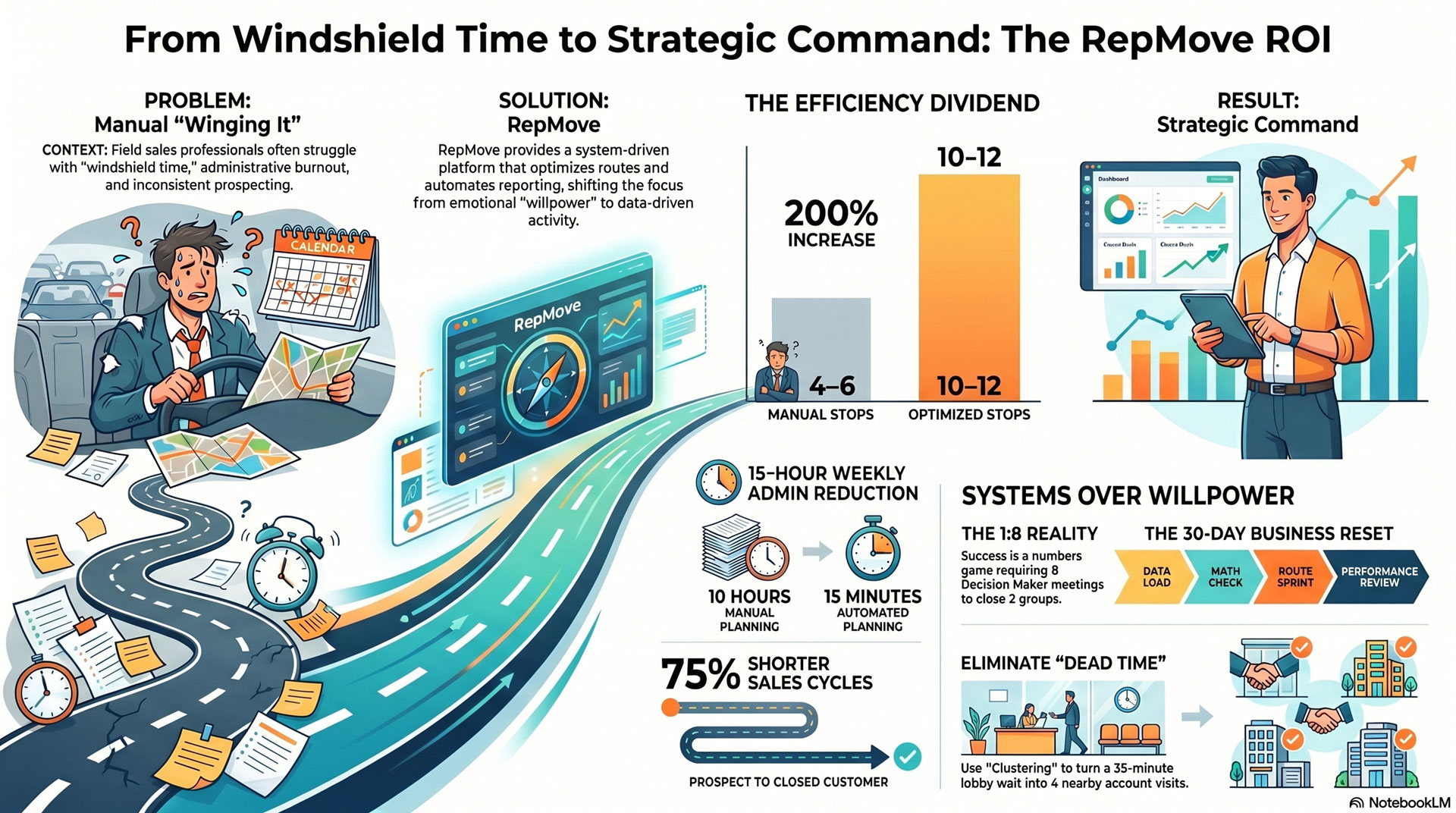
To standardize a high-performing, burnout-proof prospecting habit across the agency. This course uses data-driven math to eliminate the guesswork for rookies and leverages modern CRM efficiency to rescue veterans from burnout.
Module 1: The Equalizer – The Math of the Pipeline
Objective: Establish a universal reality check. Math doesn't care about your experience level; the numbers remain the same.
- The Universal Ratio: Reintroducing the 1-in-8 closing reality (8 DM meetings = 2 closed groups).
- The "Experience Trap" vs. "Rookie Mistake":
- The Veteran Trap: Relying too heavily on a fading legacy pipeline or "coasting" on old relationships, leading to a sudden drop in numbers.
- The Rookie Mistake: Overestimating how far a few good conversations will go and suffering from a hollow pipeline.
- Activity-Based Security: Shifting the focus from income goals to controllable daily inputs. Why knowing your exact numbers eliminates anxiety for both rookies and vets.
Module 2: The Art and Skill of Modern Prospecting
Objective: Align rookies on the mechanics of voluntary benefits while helping veterans modernize and streamline their approach.
- The Three Pillars of the Field:
- Filling the Pipeline: Uncovering new business segments.
- Qualifying Quickly: The "Fast No" is the second-best answer in sales. Saving the veteran's energy and the rookie's time.
- Selling the Meeting, Not the Benefit: Breaking the habit of over-explaining the product on the first touch.
- Peer Learning Session (The Bridge):
- Veterans share: Real stories of how voluntary benefits saved local businesses (building belief for rookies).
- Rookies share: An openness to new tech and high-energy outreach (inspiring veterans).
Module 3: Burnout Medicine – Systems Over Willpower
Objective: Directly address veteran fatigue and protect rookies from hitting the same wall.
- Deconstructing Burnout: Why it isn't "hard work" that burns agents out, but rather unorganized, unpredictable work.
- The "Guardrails" Strategy: Setting mandatory daily maximums and minimums.
- Stopping the "Hero-to-Zero" cycle: (e.g., prospecting hard for two days, getting exhausted, and doing nothing for the next two weeks).
- Mental Boundary Lines: Learning when to turn the sales brain "off." Establishing a strict "Done for the Day" metric based on activity hits, not emotional states.
Module 4: RepMove as Your Virtual Assistant
Objective: Get veterans to embrace technology to save their knees, and get rookies to use it to structure their chaos.
- Overcoming the "I've Always Done It This Way" Mentality: Showing veterans how much windshield time and fuel money they are wasting without optimization.
- Route Efficiency for Energy Conservation:
- How RepMove turns a 6-hour driving nightmare into a highly concentrated 3-hour field sprint.
- The "Clustering" Strategy: Instantly pulling up 5 nearby opportunities when a scheduled DM meeting reschedules or runs short.
- Eliminating Mental Clutter: Using the CRM to offload memory. If it’s not in RepMove, it didn't happen.
Module 5: The 30-Day Launch & Re-Launch Blueprint
Objective: Walk out of the room with an individualized, executable plan.
- The Daily Scorecard Setup: Simple tracking ($\text{Stops} \rightarrow \text{DMs identified} \rightarrow \text{Meetings set}$).
- The Veteran/Rookie Accountability Matchup: (Optional but highly recommended) Pairing a veteran and a rookie for daily 5-minute metric check-ins.
- The Vet keeps the Rookie grounded; the Rookie keeps the Vet moving.
- The First Optimized Week: Live workshop time spent building the next week's route directly inside RepMove.
Slide Deck
Quick Resources
Audio Deep Dive
Take Quiz
VIP 2 Minute Presentation
Presentation Script & Phrase Psychology
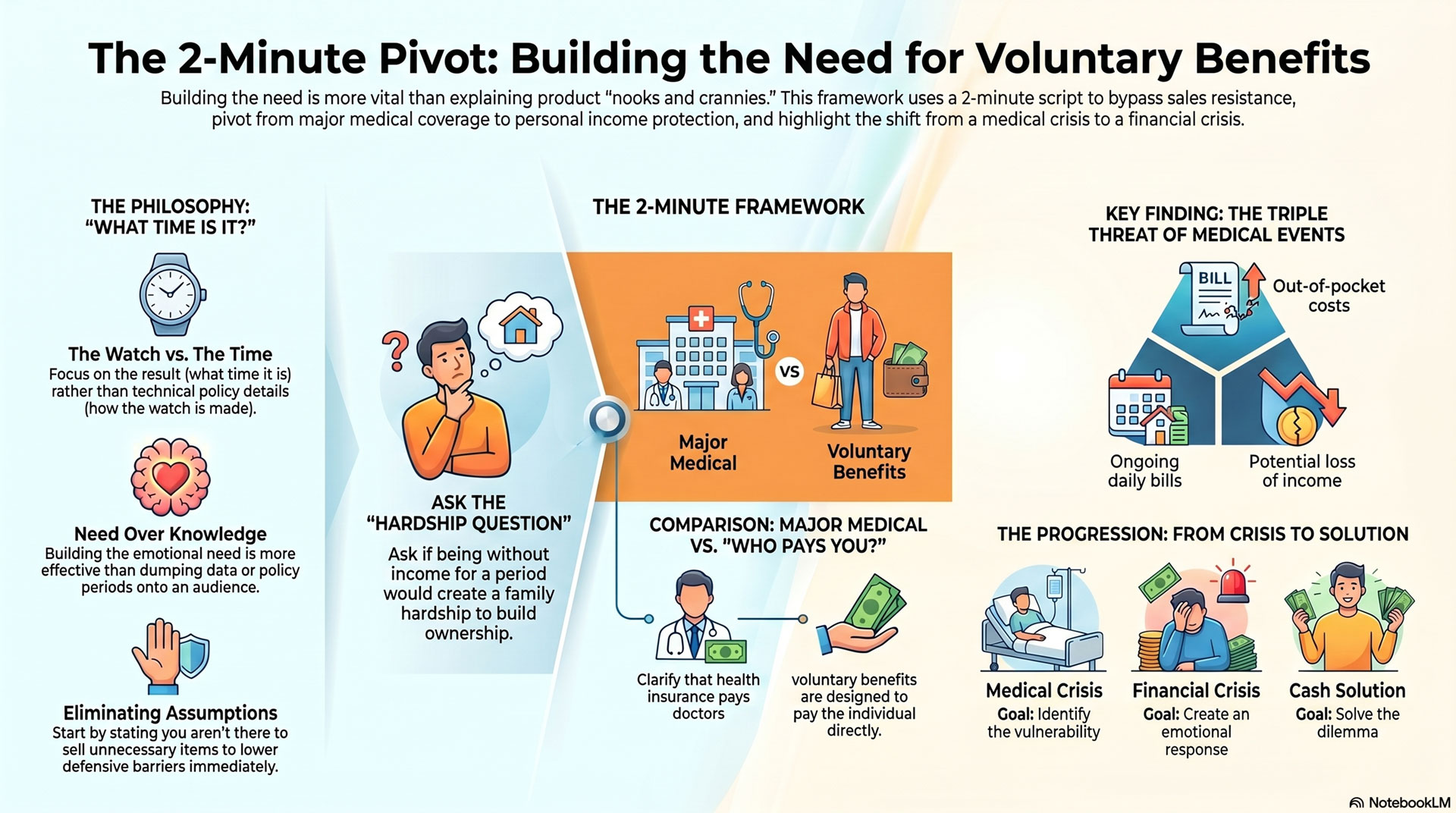
Below is the step-by-step presentation script mapped directly to the psychological strategy behind each phrase. The goal is to build the need completely before discussing what we do.
Establish Trust
Phrase: “I’m not here to sell you a bunch of stuff you don’t need.”
Psychology: Eliminate assumptions right up front! This lowers their defensive sales guard instantly.
Personalize the Risk
Phrase: “If you were without an income/paycheck for a period of time, would that be a financial hardship for you?”
Psychology: Build the character in the story—them! Ask the question about themselves to make the stakes real.
Define by Contrast
Phrase: “Let me explain what these benefits are by explaining what they are not. We are NOT major medical health insurance.”
Psychology: Eliminate assumptions again. Prevent them from confusing your solution with traditional health insurance.
Ownership of Reality (Part 1)
Phrase: “Who does major medical pay?”
Psychology: Let them answer the question so they will take ownership of how the current system works (it pays doctors/hospitals, not them).
Ownership of Reality (Part 2)
Phrase: “And who pays you?”
Psychology: Again, let them answer. This is important! It highlights the gap in their current protection.
The Three Consequences
Phrase: “There are three things that are going to happen to you if you or your family has a medical event:”
- 1. OOPS: Out of Pocket Expenses
- 2. Daily Living Expenses: Have your bills stopped because of your medical event?
- 3. Potential loss of income: Income drops while expenses rise.
Psychology: Explain and put into their minds how things practically play out when there is a medical event.
The Emotional Pivot
Phrase: “Your medical crisis has now become a financial crisis.”
Psychology: "Crisis" is a strong word and creates a necessary emotional response to the problem.
The Solution
Phrase: “That’s where we come in. We put cash in your pocket, you have the freedom to use it how you need to, and these plans are AFFORDABLE!”
Psychology: NOW we finally explain exactly what we do. We needed to build the story and explain the need BEFORE we talk about what we do. Notice we are NOT mentioning a single product?
The Temperature Check
Phrase: “Does this make sense to you?”
Psychology: Checking for understanding and gaining conceptual agreement before moving forward.
Summary: Build the Need First!
Never pitch products to a client who doesn't think they have a problem. By following this psychological framework, you establish trust, expose their financial vulnerability, and position cash-benefit plans as the logical safety net.
Slide Deck
Quick Resources
Audio Deep Dive
Take Quiz
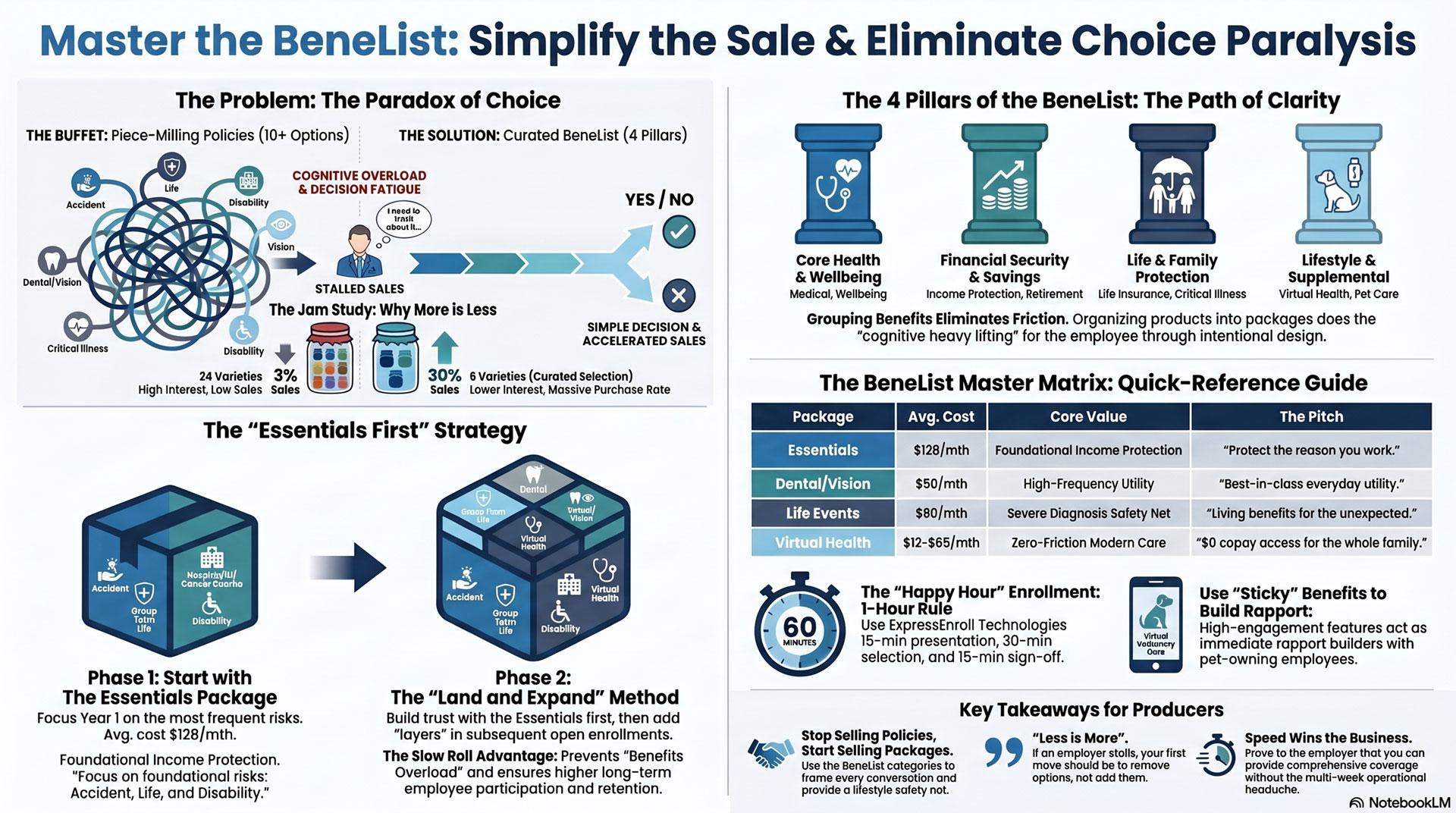
Essential Package
 Assurity Accident Insurance (Avg $20): Protect your employees in the event of an accident AND lower risks for your business.
- Assurity Group Term Life (Avg $35): Portable, GUARANTEED ISSUE*, and Simple Term Life that can cover the entire family!
- Assurity Hospital/CI/Cancer Combo (Avg $38): Comprehensive, affordable, and guarantee issue. Boost retention cost-effectively.
- Assurity Disability (Avg $35): Let's let people protect the reason they come to work.
- Scan the QR Code to set up Assurity for your business
Dental/Vision Package
 BEAM Dental/Vision (Avg $44): BEST IN CLASS Group Dental and Vision!
- BEAM ER Paid Life Insurance (Avg $6): Life insurance that you can afford for your employees!
- Scan the QR Code to set up Beam for your business
Life Events Package
 Assurity Lump-Sum CI/Cancer (Avg $35): Up to $30,000 in tax free Lump Sum Benefits when it absolutely matters most. Can pay up to 3x per covered person.
- 5Star life insurance w Living Benefits (Avg $55): Up to $100,000 in Term to Age 121 Life insurance benefits with LIVING Benefits for Chronic Care needs.
- Scan the QR Code to set up Beam for your business
Virtual Health Package
 LYRIC and Go LEXI ($12 or $65): Boost employee well-being & cut costs w LYRIC. 24/7 healthcare access, Primary Care (if selected), common prescriptions, EAP, and even VIRTUAL VETERINARY CARE through GO LEXI is included. Get healthcare with $0 copay that we can all afford.
- Scan the QR Code to set up Lyric for your business